
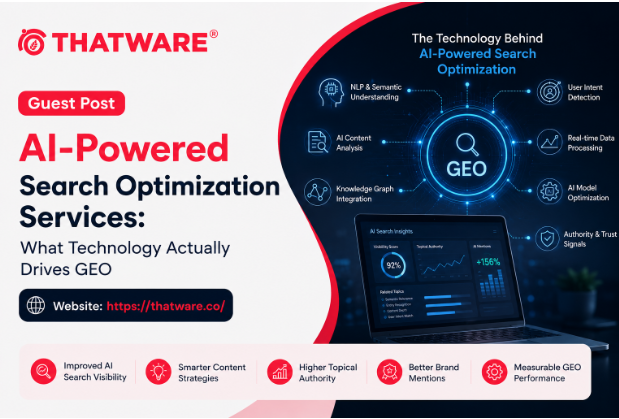
When people talk about AI search, they tend to focus on the outputs — the ChatGPT answers, the Perplexity summaries, the Google AI Overviews. What they talk about less is the machinery underneath. The actual technology that determines which sources get referenced, which brands get cited, and which content shapes how these systems respond.
Understanding that machinery isn’t just interesting from a technical standpoint. It’s practically useful, because once you see what’s actually happening under the hood, the strategy becomes a lot clearer.
A Brief, Non-Intimidating Technical Primer
Large language models learn from text. Enormous quantities of it — web pages, books, academic papers, documentation, news archives. Through training, they develop weighted associations between concepts, entities, and language patterns. When someone asks a question, the model generates a response based on those learned patterns.
What this means for content strategy is subtle but important. The model isn’t consulting a live index when you ask it something. It’s drawing on compressed knowledge that was baked in during training. Newer retrieval-augmented systems — like Perplexity, or Google’s AI Overviews — layer a live search step on top of that base, pulling in current web sources to supplement the model’s existing knowledge. But even in those systems, the base model’s sense of what’s authoritative shapes how it interprets and uses retrieved content.
So there are actually two layers to think about: the base model’s training-time understanding of your brand and topic area, and the retrieval layer that determines which pages get pulled into specific responses. Both matter, and they require somewhat different optimization strategies.
Training Data Presence: The Long Game
Getting into a model’s training data isn’t something you can do directly — you can’t submit your site to be “trained on.” What you can do is ensure that your content, and content about your brand, is present and high-quality across the web in a way that tends to get included in training datasets.
High-quality content published on authoritative domains. Consistent brand mentions in reputable publications. Wikipedia presence for established brands. Academic or research citations for claims you make. These aren’t just traditional PR or SEO signals — they’re the web footprint that training datasets draw from.
This is a longer game, but it’s worth understanding because it’s why brand authority building and GEO are deeply connected. A brand that’s been building a strong, consistent web presence for years has a structural advantage in AI search — the model has seen enough about them to develop a stable, positive representation.
The Retrieval Layer: Where Real-Time Optimization Happens
For retrieval-augmented AI systems, the optimization game is more immediate. These systems pull live content and use it to construct responses, which means your pages need to be retrieval-friendly — structured in a way that makes them useful as source material.
AI-powered search optimization services that focus on the retrieval layer are essentially making your content as useful as possible to a model constructing an answer. This means:
Clear, declarative sentences that state facts cleanly. Content that directly addresses the question being asked without lots of preamble. Specific claims backed by evidence or authoritative sources. Structured headings that signal what each section covers. Concise paragraphs that isolate individual ideas.
There’s also a practical dimension around page load speed and crawlability. If AI crawlers can’t access your content efficiently, it can’t be retrieved. This sounds basic, but it’s worth auditing — particularly for sites with complex JavaScript rendering or aggressive bot-blocking that accidentally excludes legitimate AI crawlers.
Entity Graphs and Knowledge Representation
One of the more sophisticated dimensions of GEO technology is entity graph management — and it’s something most content teams haven’t thought much about.
LLMs process the world in terms of entities (things that exist — people, companies, products, concepts) and relationships between them. Your brand is an entity. The problems you solve are entities. The people on your team are entities. How well a model understands your entity — and what other entities it associates you with — shapes how it represents you in responses.
Schema markup is the most direct way to communicate entity information to AI systems. Organization schema, with clear description, founding date, industry categories, and notable people, builds a machine-readable entity profile. Product schema, Article schema with author entities, and BreadcrumbList all contribute to a richer entity representation.
But schema alone isn’t enough. Entity presence in external knowledge bases — Wikidata, Crunchbase, LinkedIn, industry databases — reinforces the model’s picture of who you are and what you do. The more coherent and consistent that picture is across sources, the higher the model’s confidence when representing you.
Semantic Indexing and Topical Authority
Traditional SEO built topical authority through backlinks — if lots of pages about Topic X linked to you, you became authoritative on Topic X. The LLM equivalent is semantic density: does your content comprehensively and coherently cover the concepts, sub-topics, and questions that belong to a given domain?
A site that has one excellent article on a topic is less likely to be treated as an authority on that topic than a site that has fifty well-linked, consistent articles covering every important angle. The model has seen more from you, across more dimensions of the topic, and has built a richer representation of your expertise.
This is why content strategy for GEO tends to emphasize coverage and coherence over individual page optimization. You’re not just trying to rank one page — you’re trying to establish a domain of knowledge that the model learns to associate with your brand.
The Role of NLP-Friendly Formatting
There’s mounting evidence — both from researchers studying LLM citation behavior and from practitioners doing empirical testing — that certain formatting patterns improve citation rates. Content that includes clear definitions tends to be used as explanatory source material. Content that makes numbered or structured claims tends to be excerpted. Content that mirrors the question phrasing of common queries tends to be matched against those queries more reliably.
None of this requires abandoning good writing. It’s more about ensuring your content does the things good expository writing should do anyway — define terms, make specific claims, support them, and organize the information logically.
Putting the Technology to Work
The technology driving GEO isn’t magic, and it’s not entirely opaque. The more you understand about how LLMs process content, how retrieval systems select sources, and how entity graphs shape model representations, the more deliberately you can build content and infrastructure that performs in this environment.
Generative Engine Optimization services at their best are applying this technical understanding to real content programs — not just following best-practice checklists, but working from a genuine model of how AI search systems work and what they reward.
That technical layer is where the real advantage lives in 2026. Content quality matters, but content quality is informed by how AI systems actually process and use content? That’s the combination that’s starting to separate the brands winning in AI search from the ones wondering why they’re not showing up.
